World Blind Union Asia-Atlantic Chapter (WBUAP)

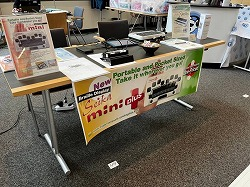
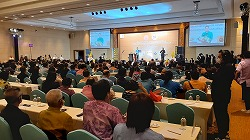
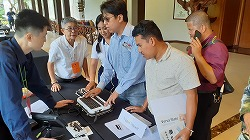
The World Blind Union Asia-Atlantic General Assembly (WBUAP) was held in Phuket, Thailand for three days from November 27th, with 300 participants from 21 member countries. Nippon Telesoft demonstrated Braille-related equipment, widely promoting the functions of the equipment to related parties.
This was Nippon Telesoft’s second time participating in the WBUAP, following its previous visit to Mongolia, and this time two companies from Korea, and one company from Malaysia, Newland, and others also took part in the exhibition.
The conference began with greetings from the WBU Chairman and Thailand’s Minister of State for Persons with Disabilities, followed by a discussion session titled “Smart City Concept for People with Disabilities” and presentations on the current situation in each of the 21 participating countries.
Sight City to be held for the first time in four years

Seika Display is popular

Sight City, Europe’s largest exhibition for the visually impaired, was held in Frankfurt, Germany from May 10th to 12th for the first time in four years. Nippon Telesoft exhibited braille printers and other products, and the latest equipment, such as the PC-embedded braille display “Studio,” attracted attention. In addition, our braille printer “GEMINI” attracted attention for its ability to print braille and ink characters simultaneously using pins designed for the US and Europe, and for its quiet printing sound with braille software compatible with various languages. It has also been decided that the product will be newly adopted in Bulgaria.

Braille printers in Cambodia

The Japanese government donated a braille printer manufactured by Nippon Telesoft to the Krousar Thamey School for the visually and hearing impaired in Phnom Penh, Cambodia, through its grassroots ODA.

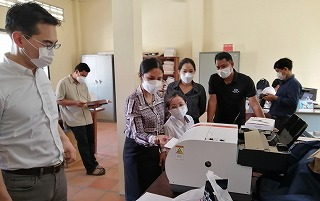
The presentation ceremony was held on January 28th, and the representative secretary from the Japanese Embassy and many teachers from the school, including Principal Para, attended to receive the braille equipment from Japan. The equipment, which includes four braille printers, 12 braille displays, and recording equipment, will be distributed to other regional branches of the school and used to print textbooks in braille and to make audio CDs.

A training session on how to use the equipment was also held at the same time, and the students learned how to use a computer and braille translation software to print Cambodian and braille at the same time. This is the first braille printer that can print braille and Cambodian at the same time in Cambodia, and the teacher said, “It’s easy to teach students because it has ink characters,” “We can make a lot of textbooks that were in short supply,” and “This is my first experience with a braille display, but I would like to use it as a device to assist in learning.” Nippon Telesoft will continue to cooperate with the project, including providing maintenance for the equipment.